Frontier AI model APIs have gotten dramatically cheaper and more capable, which has revived a familiar question for technically-minded founders: why pay for a chatbot SaaS platform when you could just call the API yourself? It's a reasonable question. The honest answer is that the API call is the cheap, easy part - everything around it is where the real cost lives.
1. What "Building It Yourself" Actually Involves
Calling a model API and getting a response back is genuinely a few lines of code. What turns that into an actual customer-facing chatbot is everything else: grounding it in your real content so it doesn't make things up, handling what happens when it doesn't know an answer, remembering context across a conversation, logging and reviewing what it says, and putting a usable widget on your site. None of that is in the API call itself.
A useful comparison is with building a website. Anyone can write a page of HTML in an afternoon, but a business site that stays fast, secure, mobile-friendly and up to date is an ongoing commitment. The chatbot is the same: the first demo is quick, and the long tail of edge cases is what takes the time.
The Part That's Actually Cheap
Frontier model API pricing has fallen sharply as providers compete on cost-efficiency - a straightforward customer support conversation, token-for-token, is inexpensive at typical small business volumes. If cost were only about the model call, building it yourself would be an easy win.
The Part That's Actually Expensive
Grounding (retrieving the right content before the model answers), fallback behavior (what it says when it doesn't know), conversation state, rate limiting, monitoring for bad answers, and an actual UI - this is the real engineering work, and it's ongoing, not one-time. A SaaS platform has already built and battle-tested this layer across many customers; building it yourself means building and maintaining it for one.
Pro Tip: If you're seriously considering build-it-yourself, price out the ongoing engineering time to maintain the grounding and fallback layer, not just the initial build. That's the number that actually determines whether DIY is cheaper.
Here is a typical sequence. Week one: a working demo that impresses everyone. Week three: someone asks a question the bot answers wrongly with total confidence. Week five: you add grounding. Week eight: visitors ask something unusual and the bot gets stuck, so you add a handoff. Month four: a model update changes behavior and you retest everything. None of these steps is exotic, but together they are a standing job, not a project that ends.
2. When Building It Yourself Actually Makes Sense
There are real cases where DIY is the right call - just fewer than the API pricing headlines suggest.
- You have dedicated engineering capacity, not just a one-time build sprint, to maintain the system as models and requirements change.
- Your use case is genuinely unusual - deeply integrated into a proprietary internal system a SaaS platform can't reasonably support.
- You're building this as your actual product, not as a support tool for a different business.
If you fall into one of these groups, building can be a sound choice, and the honest question is whether you will still be maintaining it a year from now. A chatbot that is built well and then left alone slowly gets worse, because your products, policies and prices keep changing while its answers stay frozen.
3. When Buying Makes More Sense
For most small and mid-sized businesses, the honest case for buying is simple: you get the grounding, fallback, and monitoring layer already built and maintained, and your team's time goes into your actual product instead of chatbot infrastructure.
- 1You don't have spare engineering time to maintain a support system indefinitely.
- 2You want to be live in days, not months - a SaaS platform's setup time is usually measured in hours to days, not a development sprint.
- 3You want someone else responsible for grounding quality as models change underneath you.
Buying does not mean giving up control. A good platform lets you decide what content the bot uses, what it should say when it does not know, and who is notified when a visitor needs a person. You are choosing to rent the engineering, not to hand over your judgment.
4. The Real Comparison to Run
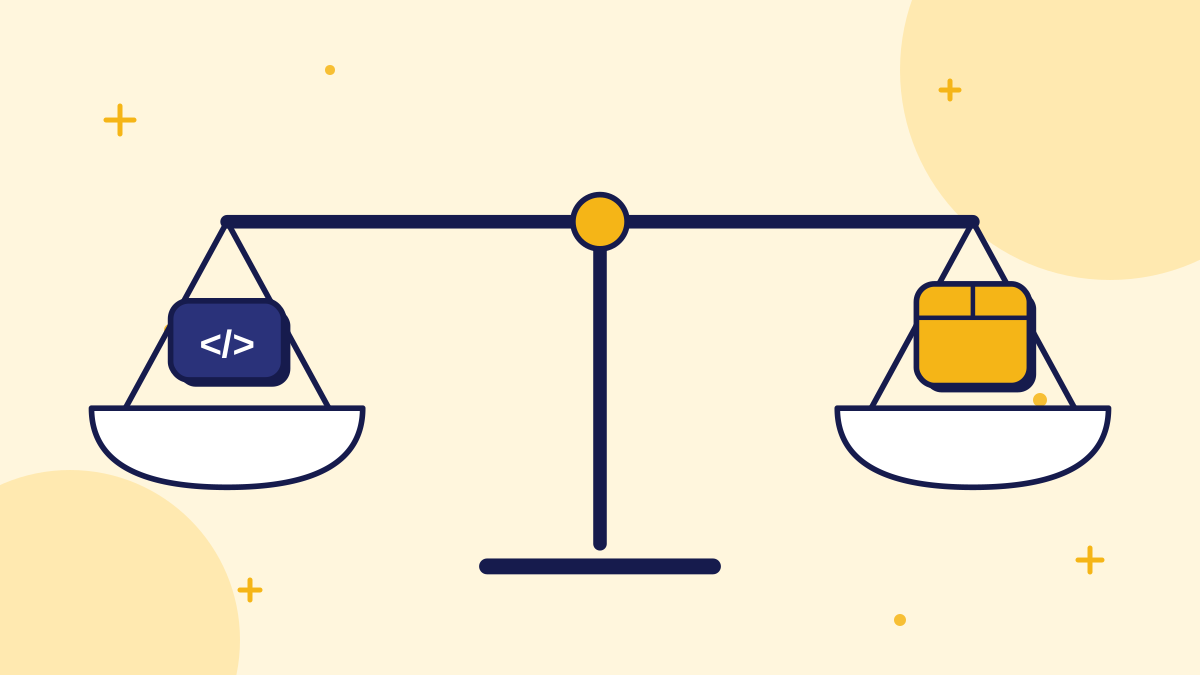
Compare total cost properly - not "API cost" versus "SaaS subscription," but total cost including your team's time. Related reading: what a chatbot SaaS plan actually costs once add-ons are factored in.
| Build on raw API | Buy a SaaS platform | |
|---|---|---|
| Model cost | Low, pay-per-use | Bundled into subscription |
| Grounding/fallback engineering | You build and maintain it | Already built |
| Time to launch | Weeks to months | Hours to days |
| Ongoing maintenance | Your team, indefinitely | Vendor's team |
| Best fit | Dedicated eng team, unusual use case | Most small/mid-size businesses |
Read the table as a prompt for your own numbers. Put a realistic hourly value on engineering time, estimate the hours needed each month to maintain grounding, handoff and monitoring, and compare the total with a subscription. Many teams find that the subscription is lower than they expected once the maintenance time is on the page.
Finally, remember that this is not a permanent decision. Many businesses start with a platform to learn what visitors actually ask, and only consider a custom build later if they hit a genuine limit.
5. A Middle Path: Buy Now, Revisit Later
The choice is not always permanent. A common pattern is to start with a platform, learn what your visitors actually ask, and only then decide whether a custom build is justified. The learning is the valuable part: after a few months you know your top questions, your volume and the places where an off-the-shelf tool falls short.
- 1Launch with a platform on a small scope. Use it to gather real data on questions and results.
- 2Keep your content portable. Maintain your Q&A pairs in a format you can export, so you are never locked in.
- 3Note the genuine limits. If you hit a real gap, such as a deep integration the platform cannot support, write it down.
- 4Revisit after a quarter or two. With data in hand, compare the cost of the gap against the cost of building and maintaining something yourself.
- 5Build only if the numbers and capacity agree. Include ongoing engineering time in the estimate, not just the first version.
This approach also protects you from a common trap: building an elaborate system before knowing what you need. Requirements discovered from real visitors are usually different from the ones imagined in a planning meeting.
Whatever you choose, keep ownership of your content. The answers you write are the lasting asset; the tool that serves them can change as your needs and the market do.
Summary
Cheap model APIs make "build it yourself" sound like an obvious cost win, but the model call was never the expensive part - grounding, fallback handling, and ongoing maintenance are. For most small businesses without dedicated engineering capacity to maintain a support system indefinitely, buying a platform that's already solved that layer is the more honest total-cost comparison.
If you're weighing this decision, price the engineering maintenance time before the model cost - that's the number that actually decides it.
Key takeaways
- Frontier model API costs have dropped significantly - the model call itself is genuinely cheap at typical small business volumes.
- The real cost of building your own chatbot is grounding, fallback handling, conversation state, and monitoring - not the API call.
- DIY makes sense with dedicated ongoing engineering capacity or a genuinely unusual use case a SaaS platform can't support.
- Buying makes sense for most small/mid-size businesses: faster launch, no ongoing infrastructure maintenance, grounding quality is the vendor's responsibility.
- Compare total cost including engineering maintenance time, not just API pricing versus subscription price.
Quick Summary
Frontier AI model APIs have gotten cheap enough that building your own chatbot sounds like an easy cost win - but the model call was never the expensive part. The real, ongoing cost is grounding, fallback handling, conversation memory, and monitoring, which a SaaS platform has already built and maintains across many customers. Build it yourself if you have dedicated engineering capacity to maintain it indefinitely or a genuinely unusual use case; buy a platform if you want to launch in days and keep your team's time on your actual product. The real comparison is total cost including maintenance time, not API price versus subscription price.
Want to see grounded answers on your own site?
Start free, add your Q&A pairs and paste one script tag. No credit card required.

Founder & CEO
Writes about grounded AI chatbots for websites: how they work, how to measure them and what to check before you buy.
Topics
Get new posts by email
Guides on AI chatbots for websites, straight to your inbox.