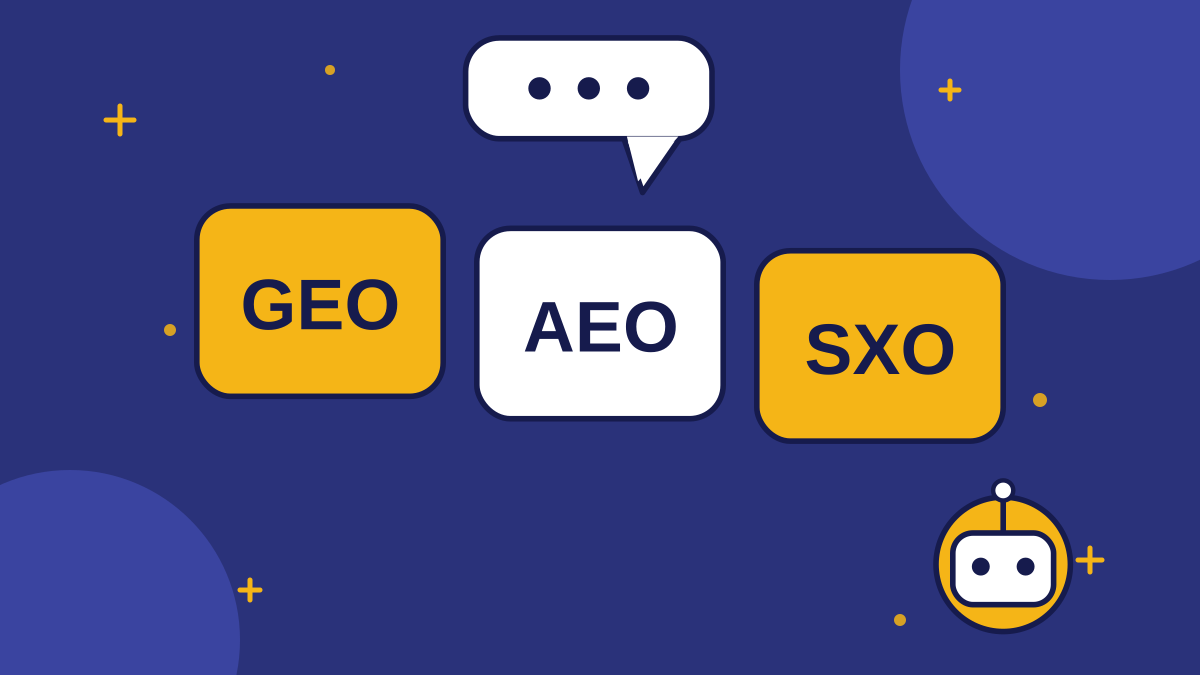
Every few months a new search acronym arrives with a pitch attached. GEO, AEO, AIO, SXO and AISEO are now all in circulation, often used to mean slightly different things. This glossary explains each in plain English, says where they overlap with ordinary SEO, and separates what is genuinely new from what is old advice in new packaging.
One honest warning first: none of these terms is a formal standard. Different writers define them differently, so check how a vendor uses a word before you buy anything labelled with it.
What Is SEO, and Why Does It Still Matter?
SEO, search engine optimization, is the work of making your website easy for search engines to find, understand and rank. Crawlable pages, clear content, useful titles and trustworthy links are still the base layer. AI features that cite websites mostly depend on pages being discoverable in the first place, so skipping SEO fundamentals undermines everything else.
What Is GEO?
GEO usually stands for generative engine optimization: making your content more likely to be used or cited in answers written by generative AI systems such as ChatGPT, Gemini, Claude and Perplexity. In practice it covers clear answer-first writing, accurate facts, authoritative mentions on other sites and letting AI crawlers read your pages.
What Is AEO?
AEO usually stands for answer engine optimization: structuring content so it can be lifted as a direct answer, whether by a voice assistant, a featured snippet, a People Also Ask box or an AI answer. The core technique is writing the answer first, in a self-contained passage under a question heading. We cover the method in how to write FAQ answers AI assistants can quote.
What Is AIO?
AIO is the most ambiguous of the set. Some writers use it for Google's AI Overviews, the AI summaries that can appear above search results. Others use it for "AI optimization" in general. When you see it, ask which meaning is intended.
What Is SXO?
SXO is search experience optimization: combining SEO with user experience so that people who arrive from search find what they wanted, quickly, and take the next step. It treats rankings as the start of the journey rather than the goal. Page speed, clear layout, honest headings and an obvious next action all belong here.
What Is AISEO?
AISEO is an informal label some people use for SEO for AI-driven search, and sometimes for using AI tools to do SEO work. The two meanings are very different, so treat any service that sells "AISEO" with the same care as any other vague claim: ask what exactly will be done and how it will be measured.
How Do They Compare?
| Term | Plain meaning | What you actually do |
|---|---|---|
| SEO | Be found and ranked in search results | Crawlable pages, useful content, clear titles, good links |
| GEO | Be used or cited in generative AI answers | Accurate answer-first pages, third-party mentions, crawler access |
| AEO | Be the direct answer to a question | Question headings with short, self-contained answers |
| AIO | Often Google AI Overviews, sometimes AI optimization in general | Same fundamentals as SEO and AEO; confirm what is meant |
| SXO | Search plus experience after the click | Fast pages, clear layout, obvious next step |
What Is Genuinely New, and What Is Old Advice?
The newest part is measurement and distribution: you now care whether an assistant mentions you, not only whether you rank, and assistants draw on third-party sources such as reviews and directories. The core advice, though, is familiar. Publish accurate, useful, well-structured content, make it crawlable and earn credible mentions.
Be sceptical of anyone who promises a guaranteed position in AI answers. Assistants vary their answers by wording and day, and the companies behind them change how sourcing works without notice. A realistic provider talks about improving the odds and measuring progress, not guaranteeing a place.
What Should a Small Business Do First?
- 1Make sure your site is crawlable and your sitemap is submitted to Google and Bing.
- 2Rewrite your top ten FAQ and service answers so each starts with a direct answer.
- 3Check your robots.txt does not block crawlers you want, as in robots.txt and AI crawlers.
- 4Fix inaccurate or inconsistent facts about your business on your site and in directories.
- 5Start a simple AI mention tracking routine.
That list serves SEO, AEO and GEO at once, which is the point. The labels matter less than the work.
What Should You Ask an Agency That Sells These Services?
Because the labels are loose, the safest test is the questions you ask. A credible provider can answer them plainly, and a vague one cannot.
- What exactly will you do each month? Look for named tasks, not buzzwords.
- How will you measure progress? Good answers mention mention rates, citations, traffic and conversions, not guaranteed positions.
- Do you guarantee rankings or citations? A yes is a warning sign, because nobody outside the assistants controls the answers.
- What do you need from us? Real expertise, accurate facts and access are usually required.
- Can we see examples and talk to references? Ask for real work you can check.
Where Should You Look Next?
If you want to go deeper on one area, start with the part that is easiest to control: your own pages. Read how to write FAQ answers AI assistants can quote, then check how assistants currently describe you with the routine in how to track whether AI assistants mention your business.
Related reading: chatbot glossary for small business, AI assistants and discovery and does a chatbot help SEO.
Conclusion
GEO, AEO, AIO, SXO and AISEO are loose labels for overlapping work. SEO makes you findable, AEO makes answers quotable, GEO aims at generative answers, SXO looks after the experience after the click and AIO and AISEO are ambiguous. Do the shared fundamentals first and be wary of guaranteed positions.
Key takeaways
- None of GEO, AEO, AIO, SXO or AISEO is a formal standard.
- SEO fundamentals still sit underneath every AI search tactic.
- AEO is about answer-first, self-contained passages; GEO is about being used in generative answers.
- AIO and AISEO are ambiguous, so ask what a provider means.
- Nobody can guarantee a position in AI answers.
Quick Summary
GEO, AEO, AIO and SXO are overlapping labels, not formal standards. SEO makes a site findable, AEO structures answer-first passages that can be quoted, GEO aims to be used in generative AI answers, SXO covers the experience after the click, and AIO and AISEO are ambiguous. Small businesses should start with crawlability, accurate answer-first content, correct robots.txt rules and consistent facts, and should distrust guaranteed positions.
Want to see grounded answers on your own site?
Start free, add your Q&A pairs and paste one script tag. No credit card required.

Founder & CEO
Writes about grounded AI chatbots for websites: how they work, how to measure them and what to check before you buy.
Topics
Get new posts by email
Guides on AI chatbots for websites, straight to your inbox.