"Agentic AI" has become one of the most repeated phrases in AI product announcements this year - every major vendor now markets "agents" instead of "chatbots." For a small business owner trying to decide what to actually use, the term is doing a lot of work without much explanation. This post breaks down what an AI agent actually is, how it differs from the chatbot you might already have, and which parts of the hype are already real versus still catching up.
1. What "AI Agent" Actually Means
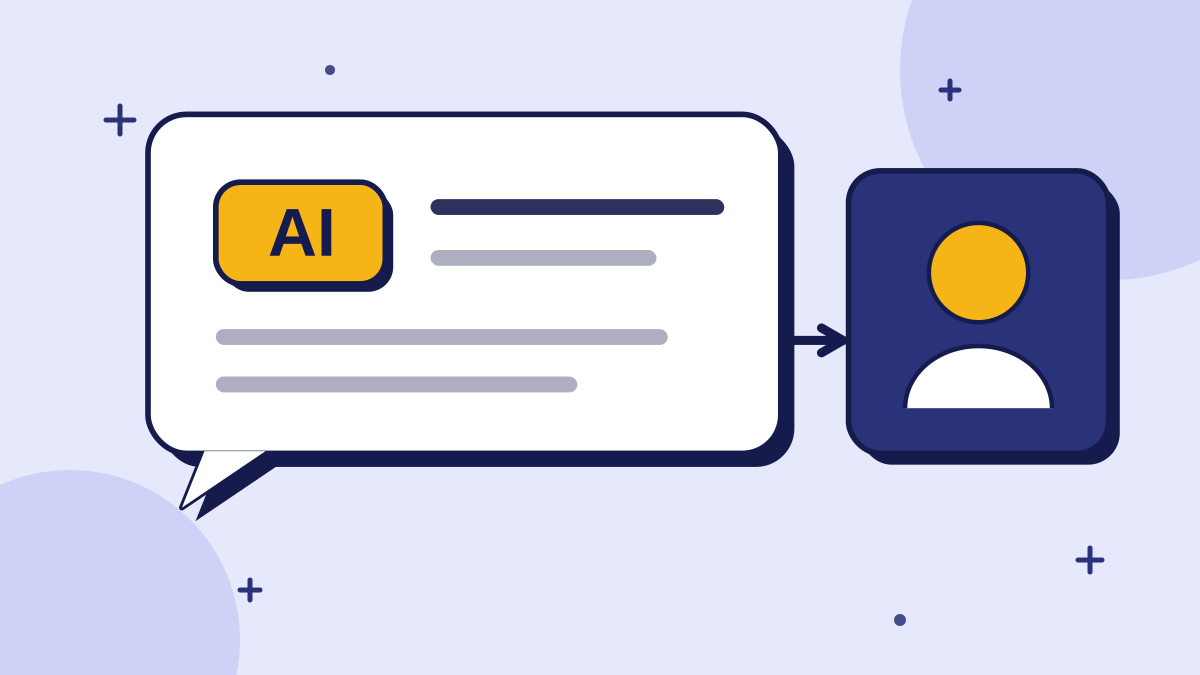
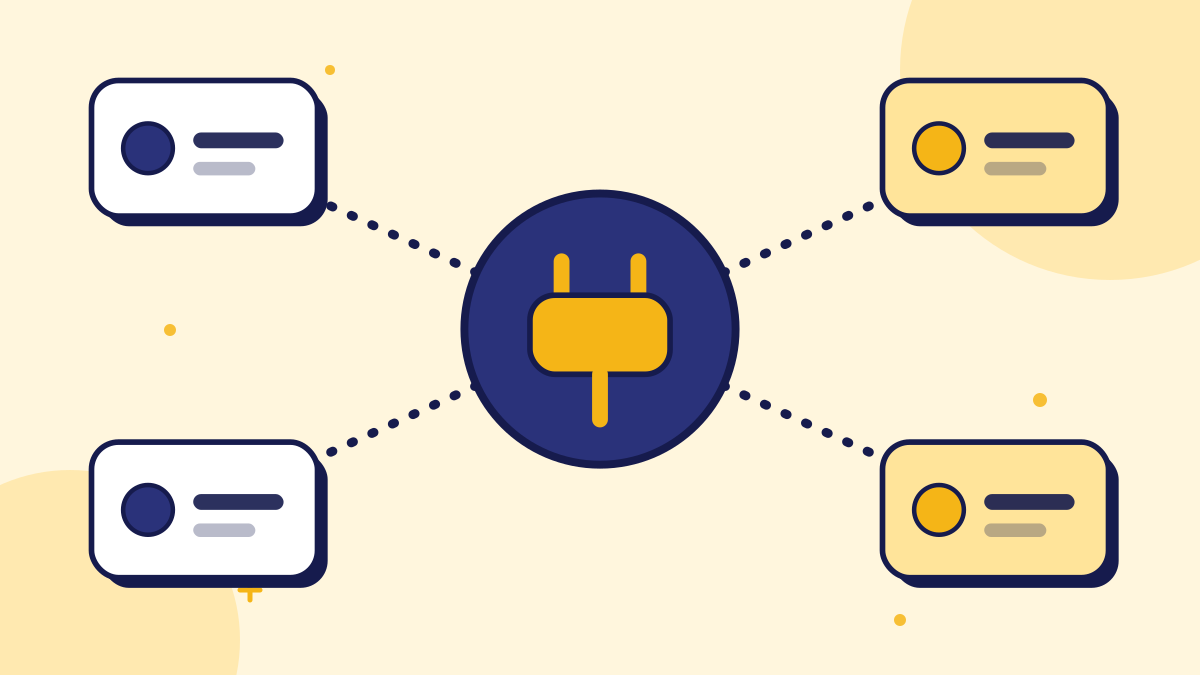
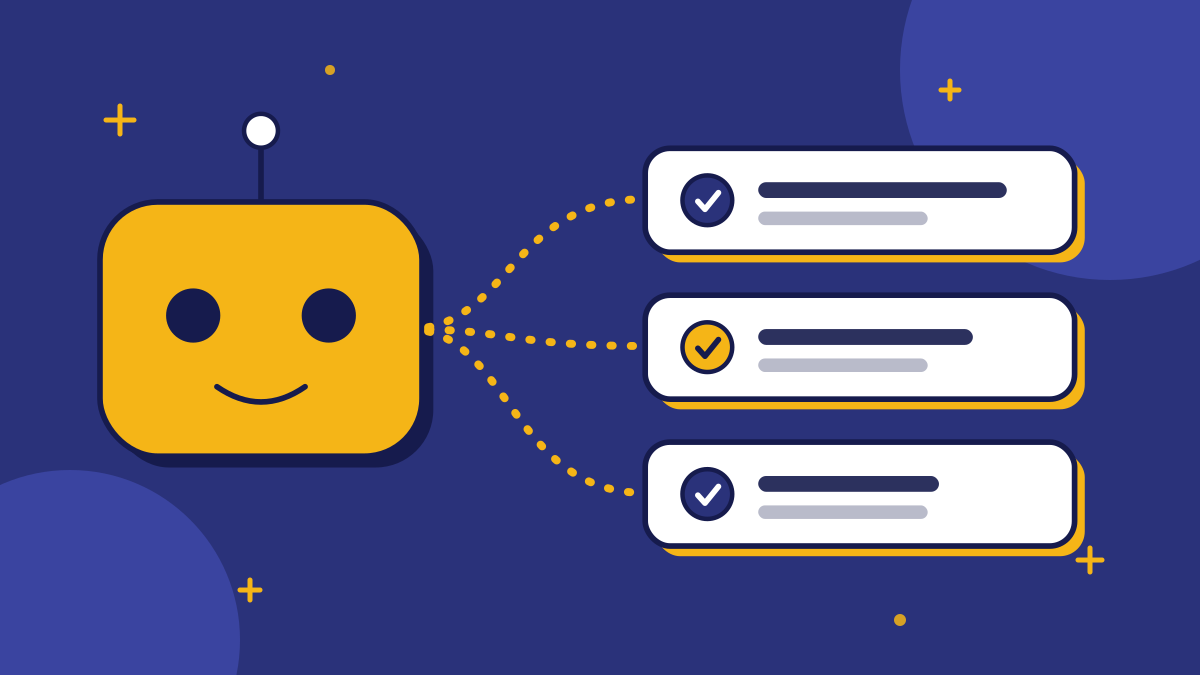
A standard AI chatbot answers questions using content you give it - it reads, it doesn't act. An AI agent goes a step further: it can take actions on your systems, usually by calling defined tools or APIs, then use the result to decide its next step. "Check this order's status," "look up this customer's account," "create a support ticket" are the kind of discrete actions an agent can chain together, rather than just describing how a human would do it.
A simple way to picture it: imagine a customer writes, "Where is my order?" A chatbot answers with your shipping policy and tells the customer to check their confirmation email. An agent looks up that customer's order in your system, reads the status, and replies with the real answer, such as "Your order shipped yesterday and is due on Friday." The customer asked the same question, but the agent did the work a human would otherwise have done.
This is also why the word "tools" matters. An agent is only as capable as the list of actions you have connected and allowed it to use. If no tools are connected, the agent is, in practice, a chatbot. If five narrow tools are connected, it can do five narrow things well, and nothing more.
Agent vs. Chatbot: The Practical Difference
The clearest way to tell them apart: a chatbot's output is always a message. An agent's output can be an action - with a message describing what it did. If your bot can only ever reply in text, it's a chatbot no matter how sophisticated the model behind it is. If it can also change something (update a record, send an email, apply a discount), it's operating as an agent.
Pro Tip: Ask any vendor pitching "AI agents" one concrete question: what specific actions can it actually take on my systems today, not conceptually? The answer usually reveals whether you're buying a chatbot with agent branding or an actual agent.
There is a second difference that matters for risk: reversibility. A wrong chatbot answer can be corrected with a follow-up message. A wrong agent action, such as an incorrect refund or a record updated with the wrong value, may already have happened by the time anyone notices. That is why the question to ask about any agent is not only what it can do, but what happens when it does the wrong thing, and whether that action can be undone.
Most real products sit on a spectrum rather than in one camp. A chatbot that can hand a conversation to a human and attach the visitor's contact details is doing a small, safe version of acting. A system that can edit your orders or issue payments is at the far end. Placing a tool on that spectrum tells you how much oversight it needs.
2. Where This Is Genuinely Useful for Small Business Support
The realistic, useful version of agentic AI for a small business isn't a general-purpose employee replacement - it's a handful of well-defined actions bolted onto a grounded chatbot.
Support work for a small team is dominated by a few repeated requests. When one person is handling email, phones and chat at the same time, the repeated, low-judgment requests are the ones that consume the day, and those are the ones an agent can take over first.
The useful test for any candidate task is three questions: is it repetitive, is the correct outcome clear and checkable, and is a mistake cheap to fix? If the answer to all three is yes, it is a good first task for an agent. If any answer is no, keep a person involved.
Good Fits: Narrow, Repeatable, Low-Risk Actions
Order status lookups, appointment rescheduling, password resets, and routing a conversation to the right human are strong early use cases - they're repetitive, well-defined, and low-stakes if something needs a human double-check. These are exactly the kind of tasks that eat a small team's time without requiring much judgment.
Take appointment rescheduling as an example. The customer asks to move their booking, the agent checks the open slots, offers two, and updates the calendar once the customer picks one. Each step is clear, the result is easy to verify, and if something goes wrong a person can simply move the booking back. Compare that with a request to waive a fee: the right answer depends on context, history and policy exceptions, which is where human judgment belongs.
Routing is another underrated fit. Deciding which teammate should handle a conversation, or flagging an urgent one, saves time without the agent ever making a commitment to the customer.
Weak Fits: Judgment Calls and Irreversible Actions
Refund approvals above a threshold, contract terms, anything involving legal or safety judgment - these should stay behind a human approval step regardless of how capable the underlying model is. An agent that can act is also an agent that can act wrong, and the cost of an autonomous mistake is higher than a chatbot giving a slightly off answer.
A useful rule of thumb is to keep a human approval step on anything involving money above a limit you choose, a change to a contract or commitment, a medical, legal or safety question, or anything the customer cannot easily undo. The agent can still prepare the work, for example by drafting the refund and summarizing the case, so the person only has to review and approve.
This split also keeps accountability clear. If a customer disputes an outcome, you want a record showing who or what decided, and a person who can explain it.
3. What's Real vs. Still Hype in 2026
Cutting through vendor marketing requires separating three different claims that get conflated.
- Real today: agents that reliably execute a small set of pre-approved actions (lookups, status checks, simple updates) with a human-reviewable log of what they did.
- Real but uneven: agents chaining multiple steps together (look up an order, then issue a refund, then notify the customer) - works well in narrow domains, less reliable the more open-ended the task gets.
- Mostly still hype: a fully autonomous agent handling your entire support function end to end with no oversight. Every credible vendor still recommends human review for anything consequential.
Pro Tip: Treat "fully autonomous" claims from any vendor as a red flag rather than a selling point. The vendors being straightest with you will tell you where they still recommend a human in the loop.
When you read a vendor page, look for evidence of the first category: named actions, a visible activity log, and clear limits. Be wary when the page describes outcomes ("resolves your support for you") without naming a single action the product can take. A claim you cannot test is a claim you should discount.
It also helps to ask how the product behaves when it is unsure. A trustworthy agent stops and hands the case to a person. An agent that always produces some action, even when the situation is ambiguous, is the kind that creates expensive mistakes.
4. How to Actually Adopt This Without Overreaching
The rollout pattern that works is the same one that works for grounded chatbots generally - narrow scope first, expand once it's proven. Related reading: if you haven't nailed the basics of a grounded chatbot yet, start here.
- 1Pick one repetitive action your team currently does manually and dislikes doing - order status is a common starting point.
- 2Require human approval on anything that moves money or changes a commitment until you've built confidence in the system's accuracy.
- 3Log every action the agent takes, not just what it said - this is what lets you audit mistakes after the fact.
- 4Expand one action at a time, not all at once, so you can isolate what's working from what isn't.
A good first project looks like this. Choose order status lookups. Connect only read access, so the agent can look up an order but cannot change it. Run it for a few weeks while a teammate reviews a sample of the conversations each day. If the answers are consistently right, add a second action, such as resending a confirmation email. Only after that consider an action that changes data.
Keep the grounded-chatbot basics in place underneath all of this. An agent that can act still needs accurate content to explain what it did and what happens next. If it answers policy questions from guesswork, the actions it takes will be built on the same shaky ground. Start with answers you trust, then add actions.
Summary
"Agentic AI" is a real shift, not pure marketing - the difference between a chatbot that only talks and one that can also act is meaningful. But for a small business, the useful version of this in 2026 is narrow and specific: a few well-defined actions with human oversight on anything consequential, not a fully autonomous replacement for your support team.
If you're evaluating a vendor pitching "AI agents," ask for the specific action list before you ask about the model behind it.
Key takeaways
- An AI agent differs from a chatbot in that it can take actions (via tools/APIs), not just answer questions.
- The realistic 2026 use case for small business is a handful of narrow, well-defined actions - not a fully autonomous support employee.
- Good early use cases: order status, rescheduling, password resets, routing. Weak fits: refund approvals, contract terms, anything requiring judgment.
- Ask vendors for the specific action list an agent can perform today, not conceptual claims about autonomy.
- Require human approval on anything that moves money or changes a commitment until the system has a track record.
- Log every action an agent takes, not just its messages - this is what makes mistakes auditable.
Quick Summary
Agentic AI means a chatbot that can take actions - checking an order, updating a record, routing a ticket - not just answer questions in text. For small businesses in 2026, the realistic and useful version of this is narrow: a handful of well-defined, low-risk actions with human approval required on anything that moves money or makes a commitment, not a fully autonomous support employee. The safest adoption path is the same as any grounded chatbot rollout - pick one repetitive action, log everything it does, and expand only once it's proven.
Want to see grounded answers on your own site?
Start free, add your Q&A pairs and paste one script tag. No credit card required.

Founder & CEO
Writes about grounded AI chatbots for websites: how they work, how to measure them and what to check before you buy.
Topics
Get new posts by email
Guides on AI chatbots for websites, straight to your inbox.