"RAG" - retrieval-augmented generation - comes up constantly in AI product descriptions, usually without much explanation of what it actually means or why it matters. It's one of the more important pieces of AI infrastructure for a business owner to understand at a basic level, because it's the mechanism that determines whether your chatbot answers from your actual content or from the model's general internet-scale training - the difference between a trustworthy answer and a confident guess.
1. RAG in Plain English
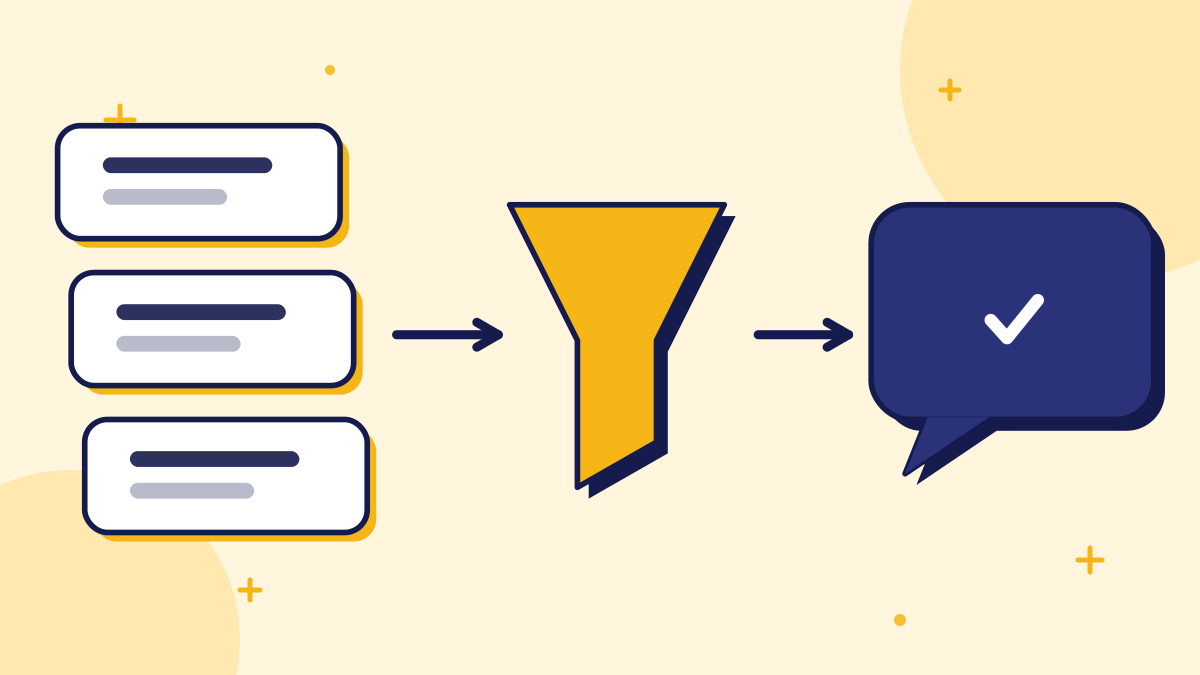
Break the term into its two halves. Retrieval: before answering, the system searches your actual content - your FAQ, policies, product pages - for the pieces most relevant to the question. Augmented generation: the model then generates its answer using what it retrieved as the basis, rather than answering purely from its general training.
Here is the process step by step. A visitor asks, "Can I return a sale item?" The system searches your content for passages about returns and sale items. It hands the best matches to the language model together with the question. The model writes an answer based on those passages. If no passage is relevant, a well-designed system says it does not have that information rather than inventing something. Retrieval first, writing second.
A Simple Analogy
Think of the difference between someone answering a question from memory versus someone who first looks up the relevant page in your actual policy document, then answers based on what's on that page. Both might sound confident. Only one is actually checking against your real information before speaking.
2. Why This Matters More Than It Sounds
A model without retrieval will still answer a question about your return policy - it just does so based on general patterns from its training data, which has no idea what your actual return policy says. That's the mechanism behind a plausible-sounding but wrong answer, and it's the core reason grounded and ungrounded chatbots behave so differently in practice. Related reading: what actually happens when a chatbot hallucinates, and why.
Pro Tip: "Grounded in your content" and "RAG" are effectively describing the same thing from different angles - if a vendor uses one term and not the other, it's still worth asking directly whether the chatbot retrieves from your content before answering, or generates freely.
Another benefit is control. With retrieval, fixing a wrong answer usually means editing your content, which you can see and change, instead of trying to retrain a model, which you cannot. That makes the system easier to maintain for a small team: update the source, and the answers follow.
3. What Good RAG Actually Looks Like
Not all retrieval implementations are equal - the quality of what gets retrieved directly determines the quality of what gets answered.
- Retrieves the actually relevant content, not just content that shares keywords with the question.
- Handles the case where nothing relevant exists by saying so, rather than generating an answer anyway from weak or irrelevant retrieved content.
- Stays current as your underlying content changes - a RAG system pointed at stale content grounds answers in the wrong version of the truth.
- Cites or reflects what it retrieved, in a way that lets you audit whether an answer was actually grounded or not.
The first point is where many systems fall down. Matching on keywords alone can retrieve the wrong passage, for example a page about "return policy" when the visitor asked about "returning a gift". Better systems match on meaning, and you can test this yourself by asking the same question in several ways and checking that each one finds the right content.
4. Questions to Ask a Vendor About Their RAG Setup
Since "RAG" and "grounded" get used loosely in marketing, it's worth asking specifically rather than taking either term at face value.
- 1Does the chatbot answer only from content I provide, or can it generate freely when retrieval comes up empty?
- 2How is content kept up to date - does it re-index automatically when I update my FAQ or policies?
- 3What happens when nothing relevant is found - does it say so, or answer anyway?
- 4Can I see what content it retrieved for a given answer, to audit whether it was actually grounded?
You do not need to understand the technical details of the answers. What you are listening for is whether the vendor can explain the behavior in plain language and show it working. Ask for a live test with a question you know is not in the content. A clear "I don't have confirmed information on that" is the result you want to see.
Keep in mind that retrieval reduces wrong answers but does not remove them entirely. Reviewing real conversations and the questions the bot could not answer remains part of running any grounded chatbot well.
5. A Worked Example
Take a small bakery with a website chatbot. The owner has added content about opening hours, custom cake orders, allergens and delivery areas. A visitor types, "Do you make gluten-free birthday cakes?" With retrieval, the system searches the owner's content and finds the custom-cake and allergen entries. It passes them to the model, which writes an answer based on exactly that information, for example that gluten-free options are available on request and that orders need notice, using whatever the owner actually wrote.
Now the visitor asks, "Can you cater a wedding for 300 people?" The owner's content says nothing about weddings. A grounded system finds no close match and says it does not have confirmed information, then offers to pass the question to the team or take the visitor's details. An ungrounded model would instead invent a plausible reply about wedding packages. Same question, very different outcome, and only one of them is safe to leave running unattended.
The example also shows where your effort goes. The better and more complete your content, the more questions the system can answer well. The questions it could not answer, such as the wedding enquiry, tell you what to add next. Over a few months, the content grows in the directions your customers actually ask about.
That is the practical value of retrieval: it makes your own content the source of truth and turns gaps into a visible to-do list rather than a hidden risk.
Summary
RAG is the technical mechanism behind the difference between a chatbot that answers from your real business content and one that generates plausible-sounding guesses from general training data. You don't need to understand the engineering to benefit from it - you just need to know to ask whether a vendor's chatbot actually retrieves from your content before answering, and what happens when it comes up empty.
That single question - grounded or not - is one of the highest-leverage things to ask before choosing a chatbot vendor.
Key takeaways
- RAG (retrieval-augmented generation) means the chatbot looks up relevant content from your business data before answering, rather than relying purely on general training.
- This is the core mechanism behind the difference between a "grounded" chatbot and one that generates plausible-sounding but potentially wrong answers.
- Good RAG retrieves genuinely relevant content, says so clearly when nothing relevant exists, and stays current as your content changes.
- "Grounded" and "RAG" describe the same underlying idea from different angles - ask directly whether a vendor's chatbot retrieves from your content before answering.
- Ask to see what content a chatbot retrieved for a given answer - this is how you audit whether it was actually grounded.
Quick Summary
RAG (retrieval-augmented generation) is the technique that lets a chatbot look up relevant content from your actual business data - FAQ, policies, product pages - before generating an answer, instead of relying purely on the model's general training. It's the core mechanism behind a "grounded" chatbot, and the reason grounded and ungrounded chatbots behave so differently when they don't know something. When evaluating a vendor, ask specifically whether their chatbot retrieves from your content before answering, what happens when nothing relevant is found, and whether you can audit what was retrieved for a given answer.
Want to see grounded answers on your own site?
Start free, add your Q&A pairs and paste one script tag. No credit card required.

Founder & CEO
Writes about grounded AI chatbots for websites: how they work, how to measure them and what to check before you buy.
Topics
Get new posts by email
Guides on AI chatbots for websites, straight to your inbox.