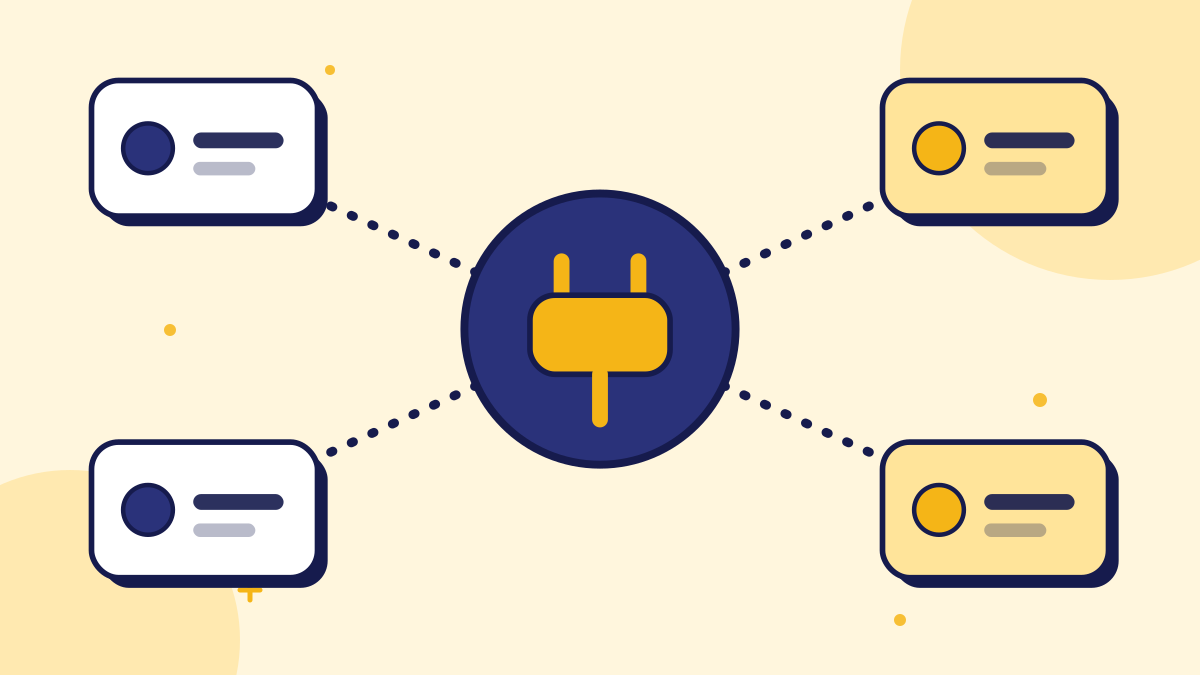
"Vertical AI" - AI products built for one specific industry rather than trying to serve every industry at once - has become a notable pattern as the AI market matures. It's a useful concept for a business owner comparing chatbot vendors, because it explains a real, practical difference in how well a product fits your actual situation, not just a marketing label.
1. Horizontal vs. Vertical, in Plain Terms
A horizontal AI tool is built to work reasonably well across many industries - a general customer support chatbot that any business, from a bakery to a law firm, could technically use. A vertical AI tool is built for one industry specifically - the terminology, workflows, and edge cases baked in from the start rather than bolted on afterward.
An everyday comparison is a general practitioner and a specialist. A general practitioner handles a wide range of common problems competently and refers on when needed. A specialist knows one area in great depth but is less useful outside it. Neither is better in the abstract; it depends on what you need today. The same logic applies to software.
In practice, the line is not always sharp. Some horizontal tools offer industry templates, and some vertical tools expand into neighbouring areas. Judge a specific product by what it does for your situation, not by which box the vendor ticks.
2. Why Vertical Tools Often Win on Fit
A general-purpose chatbot has to be configured to understand your industry's specific terms, common questions, and edge cases - work that's often left to you. A vertical tool has that understanding built in, because the company building it only has to be good at one thing.
Consider a clinic, a law practice and an online shop. A clinic needs careful handling of appointment rules and privacy. A law practice needs a bot that avoids giving advice and routes enquiries correctly. A shop needs shipping, returns and stock questions. A tool built for one of these starts with those patterns; a general tool needs you to supply them.
Where This Shows Up Practically
Industry-specific terminology handled correctly out of the box, common industry-specific questions already anticipated, and workflows that match how your type of business actually operates rather than a generic template you have to adapt.
Pro Tip: When evaluating any AI tool, ask directly whether it was built for general use or for businesses like yours specifically - the answer often predicts how much configuration work will fall on you.
Fit also affects how quickly you can launch. If the vendor has already anticipated your top questions, you spend your time reviewing answers rather than writing them from scratch. That can shorten the path to a useful first version, though you should still check every answer for accuracy against your own policies.
3. Where Horizontal Tools Still Make Sense
Vertical isn't automatically better - it depends on how standard or specialized your actual needs are.
- Horizontal fits well when your use case is genuinely general - answering FAQs, capturing leads, basic support - the same shape of problem regardless of industry.
- Vertical fits well when your industry has real specificity - specialized terminology, regulatory requirements, or workflows that a generic tool would need heavy customization to handle.
- The real question isn't "vertical or horizontal" - it's whether the tool, general or specific, was actually built to be grounded in your real content rather than generating answers freely (see what RAG/grounding actually means).
For many small businesses, the deciding factor is simple. If your questions are the common ones, such as hours, prices, delivery and booking, a well-grounded general tool will do the job and give you more flexibility. If a wrong answer could carry regulatory or safety consequences, the extra depth of a specialized product may justify its narrower scope and its price.
4. How to Actually Evaluate This
Don't choose based on the vertical/horizontal label alone - evaluate the actual fit for your specific situation.
- 1List your industry's genuinely specific requirements - terminology, common question types, regulatory considerations - before comparing vendors.
- 2Ask a horizontal tool directly how much configuration is needed to handle those specifics well.
- 3Ask a vertical tool what happens outside its core specialty - if your business has needs beyond the narrow vertical, does it handle that gracefully or not at all?
- 4Weigh grounding quality above the vertical/horizontal label - a well-grounded general tool often beats a poorly-grounded specialized one.
Try the same five real customer questions on each shortlisted product, including one outside the tool's comfort zone. Note how each answers, what each says when it does not know, and how much work it took to get there. A short side-by-side test tells you more than any feature list, and it keeps the decision based on your actual needs.
5. A Quick Decision Guide
If you are still unsure, run through this short guide. It will not give a definitive answer, but it will clarify which questions matter most for your situation.
- 1How standard are your questions? If they are the same as most businesses' questions, a general tool is likely enough.
- 2How costly is a wrong answer? If errors could cause regulatory, safety or financial harm, depth in your industry matters more.
- 3How much time can you spend configuring? A general tool needs more setup from you; a specialized one may need less but cost more.
- 4Will your needs change? If you might add services or markets, a flexible tool may suit you better than a narrow one.
- 5Can you test both? A free trial or demo with your real questions is the fairest comparison.
Whichever way you lean, keep the central principle in view: a tool is only as trustworthy as its content and its behavior when it does not know. A specialized product that guesses is worse than a general one that admits its limits.
Remember that the choice is reversible. Starting with a general tool and moving to a specialized one later, or the reverse, is common as a business learns what it needs. The value of testing early is that you find out with a small commitment.
Summary
Vertical AI - tools built for one industry rather than every industry - is a real and growing pattern, and it often does translate into a better out-of-the-box fit for businesses with genuinely specialized needs. But the label itself isn't the decision - what matters more is whether the tool, vertical or horizontal, is actually grounded in your real content and handles your specific situation well.
If you're comparing options, list your industry's real specifics first, then evaluate any tool - labeled vertical or not - against that list directly.
Key takeaways
- Vertical AI means tools built for one specific industry; horizontal AI means general-purpose tools meant to work across many industries.
- Vertical tools often fit better out of the box for businesses with genuinely specialized terminology, workflows, or regulatory needs.
- Horizontal tools work well when your use case is genuinely general - basic FAQs, lead capture, standard support.
- The vertical/horizontal label matters less than whether a tool is actually grounded in your real content, regardless of category.
- List your industry's real specifics before comparing vendors, then evaluate any tool against that concrete list rather than its marketing label.
Quick Summary
Vertical AI - tools built for one specific industry instead of trying to serve every industry - is a growing pattern in the AI market, and it often translates into a better out-of-the-box fit for businesses with genuinely specialized terminology, workflows, or regulatory needs, since the tool doesn't need heavy configuration to understand your context. Horizontal (general-purpose) tools still make sense when your use case is genuinely standard - FAQs, lead capture, basic support. The label itself isn't the decision, though: what matters more is whether the tool, vertical or horizontal, is actually grounded in your real content rather than generating answers freely.
Want to see grounded answers on your own site?
Start free, add your Q&A pairs and paste one script tag. No credit card required.

Founder & CEO
Writes about grounded AI chatbots for websites: how they work, how to measure them and what to check before you buy.
Topics
Get new posts by email
Guides on AI chatbots for websites, straight to your inbox.