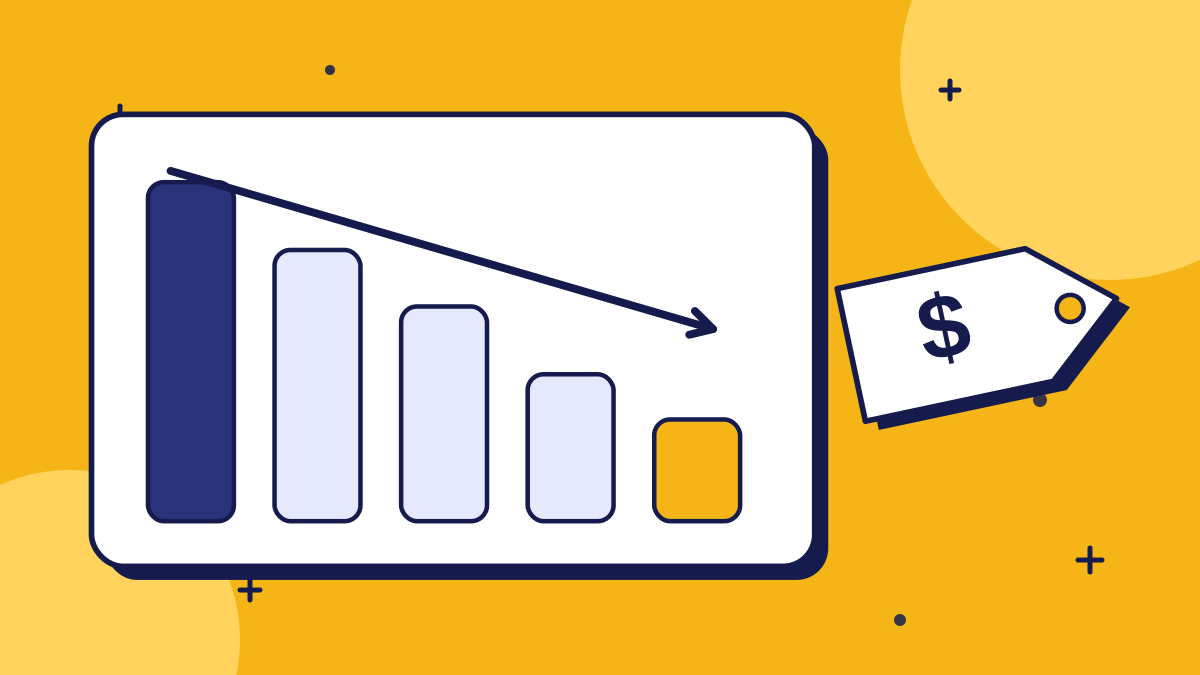
One of the clearest, least-hyped trends in AI over the past couple of years is that the cost of getting a given level of intelligence out of a model keeps dropping. It doesn't get the headlines that a flashy new model launch does, but it's arguably more directly useful to a small business owner, because it shapes what you should reasonably expect to pay for AI-powered support - and what a vendor's pricing tells you about how up to date they actually are.
1. What's Actually Driving the Cost Drop
A few forces are compounding here. Model providers are in genuine competition with each other, which pushes pricing down directly. Techniques for running models more efficiently (better hardware utilization, smaller specialized models for narrower tasks, caching repeated context) keep reducing the compute needed for a given quality of answer. And as the market matures, providers increasingly compete on cost-efficiency as a selling point in its own right, not just raw capability.
For a small business, the key point is that you do not need to follow these technical developments. You need to notice their effects: what a vendor offers for the money today compared with a year ago, and whether the product keeps improving while the price stays reasonable. The savings, when they arrive, show up as better value rather than as a dramatic price cut.
Not Every Model Gets Cheaper - Smarter Models Cost More
It's worth being precise here: the newest, most capable "frontier" models are often priced at a premium when they first launch. The cost drop shows up when you compare *equivalent* capability over time - what cost a lot to run two years ago is now available much more cheaply, even if the absolute newest model is still priced high.
This matters when reading announcements. A headline about a cheaper model does not mean the best model is cheaper. It usually means a model of a given quality level is cheaper than before. Many support questions, such as hours, delivery times and policies, do not need the most advanced model at all, which is where the efficiency gains help most.
2. What This Should Mean for Your Support Budget
If the underlying cost of running a chatbot has been falling, that's a reasonable thing to expect reflected somewhere in what you pay - either through lower prices, more included usage, or better capability at the same price point over time.
Pro Tip: When a vendor raises prices, ask specifically what's driving it - new capability, or just margin. Efficiency gains in the underlying models are real, and a vendor that's never adjusted pricing to reflect any of that is worth a second look.
A sensible expectation is gradual improvement. Ask your vendor what has changed in the last year: faster replies, better handling of tricky questions, more included conversations, new features. If the answer is "nothing", that is useful information when your renewal comes up.
3. Where the Savings Actually Show Up (and Where They Don't)
Cheaper model costs don't automatically mean a cheaper chatbot bill, because the model call was never the majority of what you're paying for in a SaaS platform - see our build vs. buy comparison for why. What falling model costs *should* do is make more capability available at your current price point over time: better grounding, better handling of edge cases, more included conversation volume.
- Reasonable to expect: more capability or included usage at a stable price over time.
- Not automatic: a lower headline subscription price, since infrastructure, support, and product development are separate costs from the raw model call.
- Worth watching for: a vendor whose pricing has stayed flat or risen with zero corresponding capability improvement.
A helpful way to think about it is to separate three layers of cost: the model itself, the engineering that makes it reliable for your business, and the support and maintenance around it. Falling model prices affect the first layer most. The other two depend on the vendor's own costs and choices, which is why total price changes more slowly than the headline numbers suggest.
4. What to Actually Do With This Information
Use falling model costs as one input into vendor evaluation, not the whole decision - it's context, not a guarantee of savings.
- 1Revisit your chatbot pricing annually, not just at initial signup - the market is moving fast enough that a good deal a year ago may not be competitive now.
- 2Ask vendors directly how they've passed efficiency gains through to customers, and listen for a specific answer versus a vague one.
- 3Weigh capability alongside price - more included features at the same cost is a real form of savings even without a lower sticker price.
When you review pricing, bring three numbers: what you pay now, what you paid a year ago, and what you got for each. Compare capability and usage limits, not only the price. If you are paying more for the same, ask why; if you are paying the same for more, the market is working as expected. Either way, you will negotiate and choose from knowledge instead of habit.
5. Questions to Ask at Renewal Time
Renewal is the natural moment to apply all of this. Many businesses auto-renew without a second look, which is exactly when a short review pays off. Before you renew, gather your usage for the past year and ask the vendor a handful of specific questions.
- What has improved in the product since I signed up? Look for specific changes, not general statements.
- What are my current usage limits, and have they changed? More included conversations at the same price is a real benefit.
- What would my cost be at higher or lower usage? Understand how the bill scales before you need it to.
- Are there plans that better match my actual usage? Many businesses pay for more than they use.
- What are my options if I want to leave? Check how to export your content and conversations.
Keep the tone friendly and factual. Vendors generally prefer to keep customers and will often adjust plans or explain changes when asked directly. If the answers are vague, that is a useful signal for how the relationship will go.
Also compare against at least one alternative, even if you plan to stay. A quick look at what another provider offers for your usage level is the quickest way to calibrate whether your current price is fair.
Summary
The steady drop in cost for equivalent AI capability is one of the more quietly important trends shaping what's realistic to expect from a support chatbot budget. It won't automatically mean your bill goes down, but it's a reasonable basis for expecting more capability at a stable price over time - and a useful lens for evaluating whether your current vendor is keeping pace.
If you haven't reviewed your chatbot pricing and included capability in the last year, that's a reasonable prompt to do it now.
Key takeaways
- The cost of running equivalent AI capability has been falling steadily, driven by provider competition and efficiency improvements.
- Newest frontier models are often priced at a premium at launch - the cost drop shows up comparing equivalent capability over time, not the absolute newest model.
- Falling model costs don't automatically mean a lower chatbot subscription bill, since the model call is only part of what a SaaS platform charges for.
- A reasonable expectation: more capability or included usage at a stable price over time, not necessarily a lower sticker price.
- Revisit chatbot vendor pricing and capability annually - the market moves fast enough that last year's good deal may not be competitive now.
Quick Summary
The cost of running equivalent AI capability has been falling steadily, driven by competition between model providers and ongoing efficiency improvements - though the newest "frontier" models are still often priced at a premium when they first launch. This trend doesn't automatically mean a lower chatbot subscription bill, since the raw model call is only part of what a SaaS platform charges for, but it's a reasonable basis for expecting more capability or included usage at a stable price over time. Worth revisiting your vendor's pricing and capability annually rather than assuming last year's deal is still competitive.
Want to see grounded answers on your own site?
Start free, add your Q&A pairs and paste one script tag. No credit card required.

Founder & CEO
Writes about grounded AI chatbots for websites: how they work, how to measure them and what to check before you buy.
Topics
Get new posts by email
Guides on AI chatbots for websites, straight to your inbox.